


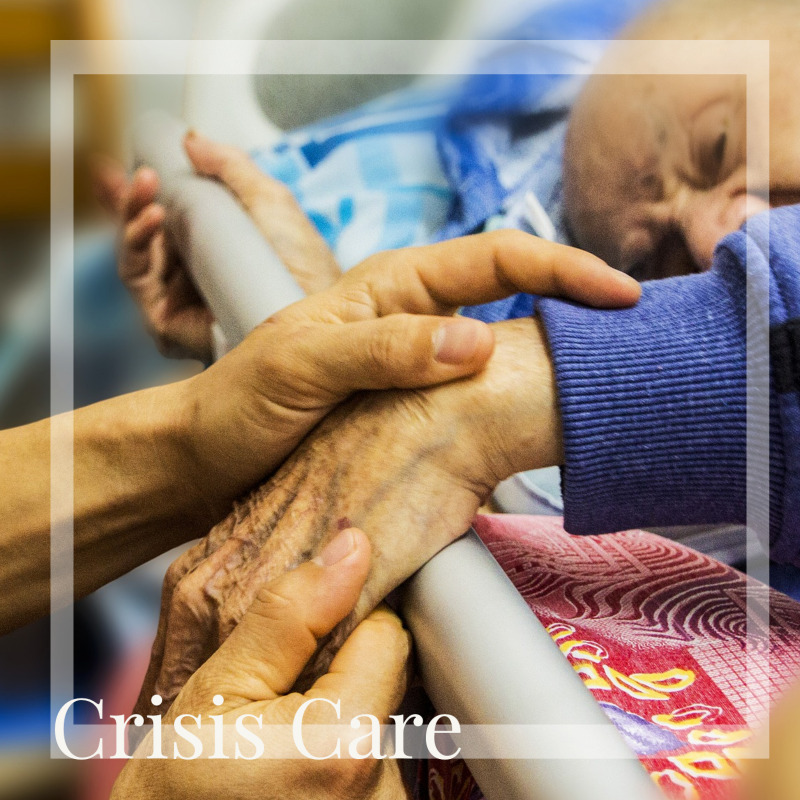
 Crisis Care Hospice is a level of care offered for all terminal patients in a hospice program and is one of four types of hospice care covered by the Medicare Hospice Benefit. This is a type of care that is offered generally in shifts or around the clock and is generally provided in the home for brief periods of time (shifts, usually) when the patient is experiencing an acute crisis. It is generally designed to honor a patient’s and family’s wish to remain at home, by providing the necessary care needed to control the patient’s acute symptoms, until the crisis is resolved or the patient passes peacefully.
When may Crisis Care be Initiated?
Accordingly, the (CMS) regulations generally state:
“Continuous home care may only be provided during a period of crisis as necessary to maintain an individual at home. A period of crisis is a period in which a patient requires continuous care that is predominantly nursing care to achieve palliation or management of acute medical symptoms.”
This type of care may also be provided in the patient’s home or an assisted living facility. It is generally specific for home care patients since the assisted living facilities have nursing available, generally 24/7.
It is not appropriate for patients in the hospital, inpatient hospice unit, or skilled nursing facility.
Symptoms that may Require Crisis Care?
Crisis Care Hospice is to alleviate uncontrolled symptoms in a time of acute crisis. Below are some examples of symptoms may include:
● Severe pain (intractable pain)
● Bleeding
● Acute respiratory distress
● Intractable (uncontrollable) vomiting or nausea
● Terminal agitation or restlessness
A hospice patient may be actively dying or imminent, however, if their symptoms are under control. They will not qualify for Crisis Care, under the CMS regulations and guidelines. Here at Angels Grace Hospice and Palliative Care, we can provide Crisis Care to our patients under the qualifications according to CMS. Our goal at Angels Grace Hospice is to achieve a peaceful death with comfort, quality, and dignity.
At Angels Grace Hospice, in Bolingbrook, IL we provide customized care plans specific to each of patients and their families. We provide end-of-life care at home, hospitals, skilled nursing homes or assisted-living facilities depending on individual circumstances.
Contact us with any questions and for further assistance with your end-of-life care options.

A Staff Story
This came from Nicole, one of our Registered Nurse Case Managers, who shared this beautiful story.
. . . .
I cared for a patient with end‑stage dementia for three years, long enough that she became part of the rhythm of my weeks and part of the landscape of my career. She wasn’t able to walk, talk, or participate in her care, and for the last year she rarely spoke at all. But in the earlier days, she had a few phrases she would offer at unexpected moments — “I love you,” “You’re beautiful,” or “Thank you.” Those were the only words she ever said, and even though they faded with time, they stayed with me. They were small reminders that somewhere inside the dementia, a piece of her still reached outward.
She had a caregiver who lived with her for seven years, one of the most dedicated caregivers I’ve ever worked with. Her daughter was just as remarkable — she didn’t live in the home, but she was there several times a week, always involved, always trying to solve problems, always wanting her mom to be as comfortable as possible. Their love for her was steady and visible in everything they did.
At one point, I even cared briefly for her husband when he suffered a stroke. He was only on hospice for a few days, but it deepened my connection with the family. After he passed, I continued caring for her, and the bond between all of us only grew stronger.
As her decline progressed, the family needed more reassurance, more guidance, more presence. Every end‑of‑life journey is unique, and hers was no exception. Even on days when I was supposed to be on PTO, I found myself going to see her because I knew how much it meant to her daughter and caregiver — and because it meant something to me, too. After three years together, showing up didn’t feel like an obligation; it felt like the natural thing to do.
Losing her was sad in a way that’s hard to explain to people outside hospice. When you see someone twice a week for years, they become part of your routine, part of your emotional landscape. And when they’re gone, you don’t just lose the patient — you lose the relationship you built with the daughter, the caregiver, the home, the quiet familiarity of the space. It’s a shift that takes time to settle.
But I’m grateful I was there for her and for her family. They were appreciative, but the truth is, the privilege was mine. Being trusted in those final years, and especially in those final days, is something I’ll carry with me for a long time.